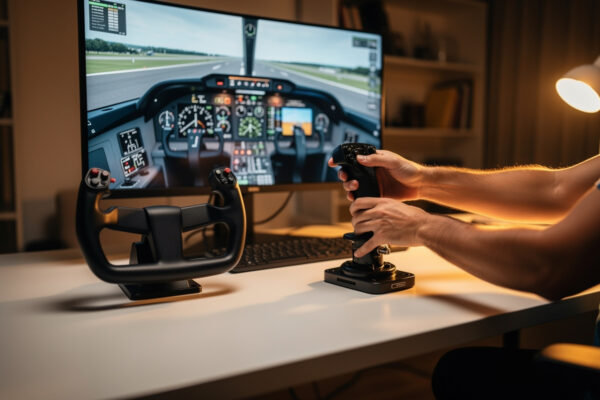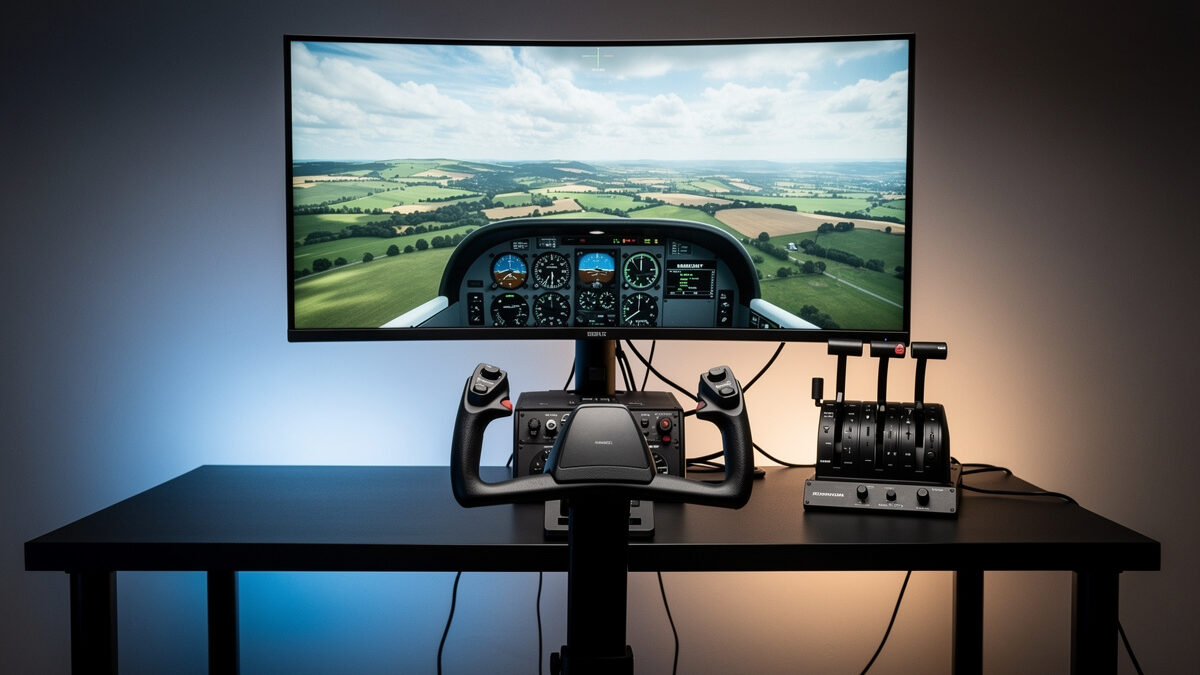
If there is one place the yoke-versus-stick debate has a clean, almost unarguable answer, it is general aviation. A GA aircraft — your Cessna 172, your Piper, your Bonanza, your King Air — was built around a control yoke, and flying one in the sim with a yoke is the difference between the aircraft feeling like a stable machine you trim and ride, versus a nervous thing you wrestle. I fly GA most evenings on my deck, switching between a Logitech G yoke and a Honeycomb Alpha-class yoke depending on what I’m comparing, and this is the argument I make every time someone asks why I don’t just use the stick for everything.
The case isn’t aesthetic. It’s mechanical, and it comes down to three things: travel, two-handed control, and the trim-driven way a GA aircraft is actually flown. Get those three and you’ll understand why the yoke isn’t a preference for general aviation — it’s the matched tool.
Reason One: Travel Matches How a GA Aircraft Is Flown
A GA aircraft is a stable platform. You set a pitch attitude, you trim off the control pressure, and then you make tiny corrections — half a degree of pitch, a gentle bank into a turn. A yoke’s long fore-and-aft travel gives you the physical resolution to make those tiny corrections precisely. The same input distance on the controller spreads across a bigger hand movement, so a small intended change is a small, controllable hand motion.
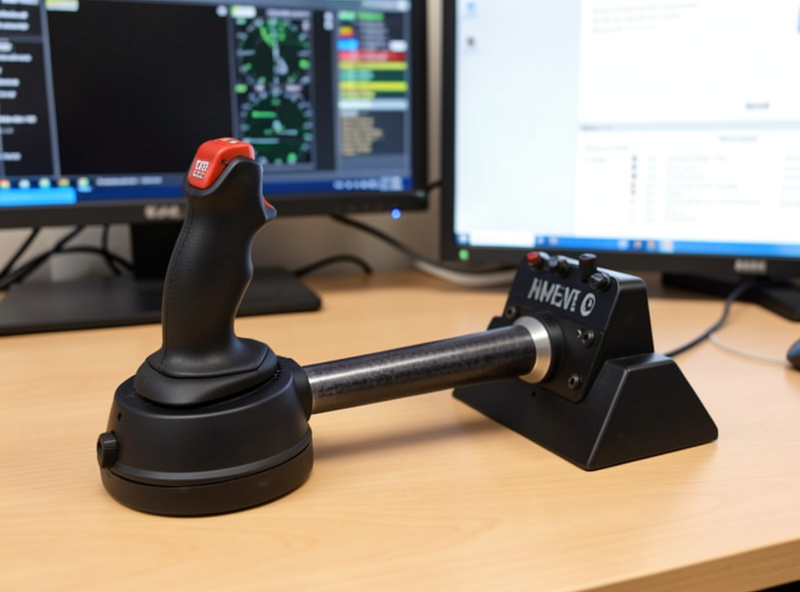
A stick, by contrast, packs the entire pitch range into a short throw. That’s perfect for a fighter that needs fast, large inputs, but for a 172 it means your smallest comfortable hand movement is already a noticeable pitch change. The aircraft feels nervous near neutral, and you find yourself overcorrecting on final approach. That nervousness isn’t your skill — it’s a short-throw tool on a long-throw aircraft. I see new simmers blame themselves for it constantly; it’s actually the wrong-controller signature I describe in yoke or stick for MSFS 2024.
Reason Two: Two Hands, the Way the Cockpit Was Designed
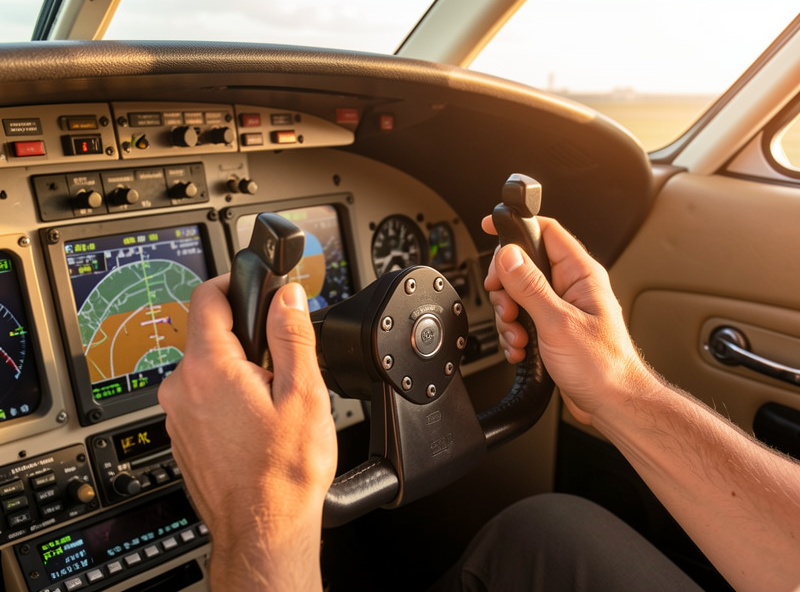
A real GA cockpit invites both hands on the column, especially when it matters — short final in a crosswind, a go-around, a busy pattern. A yoke puts your sim hands in the same place. You can fly one-handed in cruise and bring the second hand in for the demanding moments, exactly the rhythm the aircraft was designed around. On my deck, the moment a yoke earns its keep over a stick is a gusty crosswind landing, where having both hands available for fine column input is genuinely steadier.
A stick is a deliberate one-handed instrument. That’s a strength for a fighter or an Airbus where the other hand lives on the throttle, but for hand-flying a light aircraft through weather, the yoke’s two-handed option is the more natural fit. It’s a small thing until hour two of a bumpy cross-country, and then it isn’t small at all.
Reason Three: Trim Discipline Feels Right on a Yoke
Here’s the subtle one that separates simmers who understand GA flying from those who don’t: a properly flown GA aircraft barely moves the yoke in cruise, because you trim away the pressure. The yoke sits near neutral, lightly held, and you fly attitude with trim. That whole discipline — set, trim, relax — feels correct on a yoke because the yoke’s resting position and light centre pressure mirror a real column. On a stick, the constant slight muscle tension to hold a short-throw axis near a precise point quietly undermines the trim-and-relax rhythm.
This is the kind of thing you only notice after flying both for a while, and it’s exactly why I keep both on the deck. The yoke doesn’t just match the GA aircraft’s geometry — it matches its workflow. The full aircraft-type breakdown, including where this flips in favour of the stick, is in my yoke vs stick guide.
Yoke vs Stick for GA, Side by Side
The verdict from flying both classes on the same GA aircraft.
| Flying a GA aircraft | Yoke | Stick |
|---|---|---|
| Small trimmed corrections | Precise (long travel) | Twitchy near neutral |
| Crosswind landing feel | Two-handed, steady | One-handed, workable |
| Trim-and-relax cruise | Natural, light centre | Slight constant tension |
| Authenticity to the airframe | Matches the column | Not how it’s built |
| Out-of-box feel | Good, small deadzone fix | Needs response curves |
The One Honest Caveat
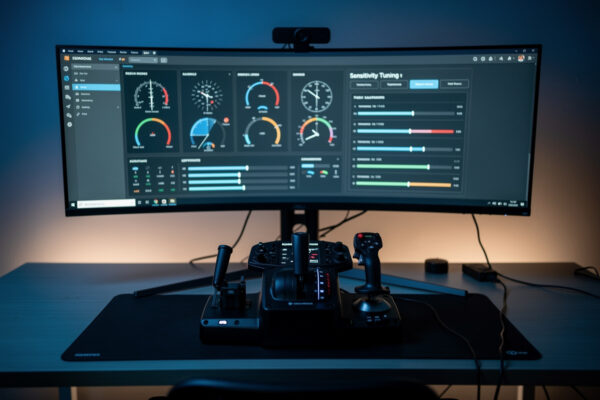
None of this means a stick can’t fly a GA aircraft — it can, and with good response curves it can fly one well. If you already own a stick and you mostly fly GA, don’t panic-buy a yoke; tune your curves first and see how far that gets you. But if you’re buying fresh and you know GA is your home, the yoke is the matched tool and it removes a whole category of frustration before it starts. The reasoning for tuning a stick to behave, versus buying the right tool, is something I weigh honestly in the main guide.
And one more frame I never drop on this site: flying a GA aircraft well in the sim — trimming it out, greasing a crosswind landing — is a genuinely satisfying skill, but it is sim skill. It builds familiarity and hand-eye coordination, not flight competency. Real general aviation is learned in a real aircraft with a licensed instructor. The yoke makes your sim flying better; it doesn’t make you a pilot.
The Yoke I’d Point You To
If the GA argument has convinced you, the yoke is the buy. You can browse the current flight sim yokes to match your budget, and a matched throttle quadrant is the natural companion for GA flying — separate throttle, prop, and mixture levers turn a yoke setup into a proper GA control suite. As an Amazon Associate I earn from qualifying purchases.
Why is a yoke better for GA aircraft in flight sim?
A yoke’s long travel gives precise resolution for the tiny trimmed corrections GA flying needs, offers natural two-handed control for crosswind landings, and matches the trim-and-relax workflow the airframe was designed around. A stick’s short throw makes the same aircraft feel nervous.
Can you fly a Cessna 172 with a joystick?
Yes, but it feels twitchy near neutral because a stick’s short throw maps small movements to large deflections. Response curves help, but you are softening a stick to imitate a yoke. For GA, a yoke is the matched tool.
Do I need a yoke for general aviation flight simming?
You do not strictly need one, but it is the best-matched controller for GA aircraft. A yoke removes the nervous overcorrecting feel a stick gives light aircraft and mirrors how a real control column is flown with trim.
What makes the yoke feel right on a GA aircraft?
Three things: long travel for precise small inputs, two-handed control for demanding moments like crosswind landings, and a light near-neutral resting position that matches trimmed cruise. Together they mirror how the real column is flown.
Should I buy a yoke or tune my existing stick for GA?
If you already own a stick and mostly fly GA, tune your response curves first before spending. If you are buying fresh and GA is your focus, a yoke is the matched tool and avoids a whole category of frustration.
More From the Deck
- Yoke vs Stick: The Full Aircraft-by-Aircraft Guide
- Yoke or Stick for MSFS 2024
- The Flight Sim Hardware Upgrade Order
More from This Cluster
- “The Real Cost of Switching Yoke to Stick Later”
- “Curves and Deadzones: Making Any Flight Sim Controller Disappear”
- “The Helicopter Question: Why a Stick Is Only Part of the Answer”
- “Airliner Control Logic: Why the Airbus Uses a Sidestick”
- “Yoke or Stick for MSFS 2024: The Most Common Wrong Purchase”
- “Yoke vs Stick for Flight Sim: Which to Buy for the Aircraft You Actually Fly”