The helicopter question is the one place where “yoke or stick?” simply doesn’t have a clean answer, and it trips up a lot of simmers who assume a stick covers everything. A helicopter is not flown like a fixed-wing aircraft at all. It has a cyclic, a collective, and anti-torque pedals, and they work together in a way no single yoke-or-stick purchase addresses. If you’re getting into helicopter simming, you need to understand the three-control problem before you spend, because the obvious stick is only one-third of the answer.
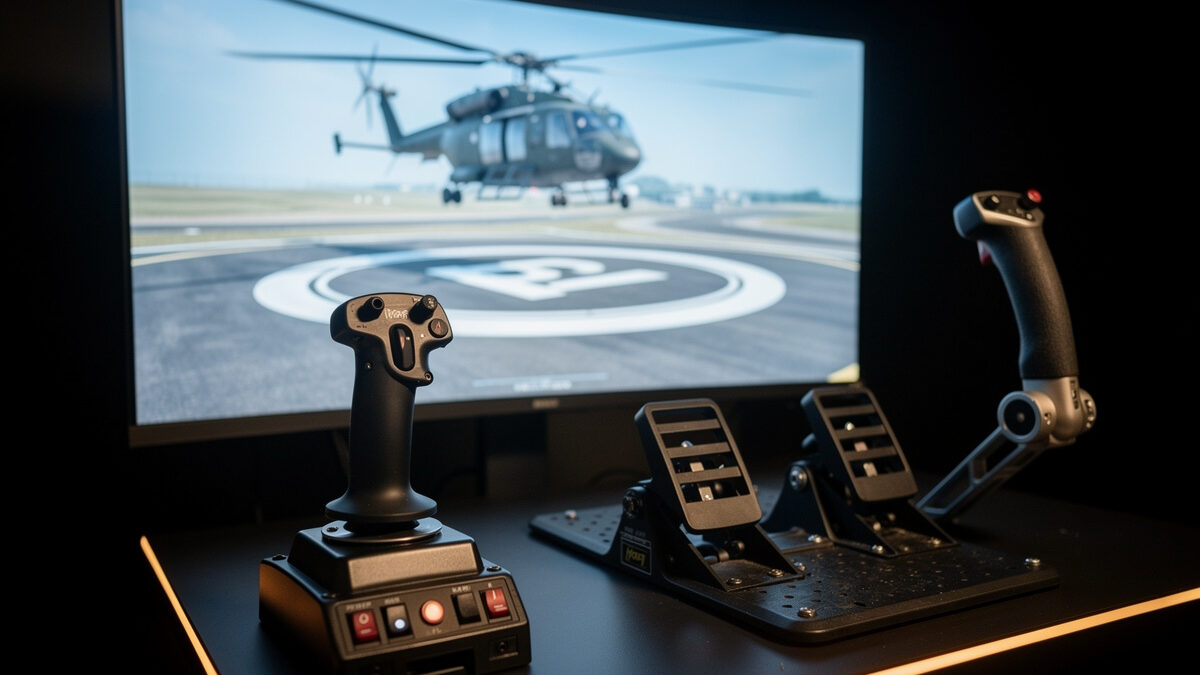
I fly helicopters on my deck with a stick standing in for the cyclic, my Thrustmaster TPR-class pedals doing the anti-torque work, and the collective as the genuine open question. This is the honest breakdown of what a stick does and doesn’t solve for rotary flight, and what the real third-control decision looks like.
The Three Controls a Helicopter Actually Uses
A helicopter is flown with three coordinated inputs, and all three are always live. The cyclic is the stick between or beside your legs that tilts the rotor disc — it controls where the helicopter goes horizontally, pitch and roll. The collective is the lever by your side that you raise and lower to change the pitch of all rotor blades together, controlling climb and descent — it’s your up-and-down. The anti-torque pedals control the tail rotor to manage yaw and counter the main rotor’s torque.
The thing that makes helicopters hard, and so satisfying when it clicks, is that every input affects the others. Raise the collective and you need more anti-torque pedal and a cyclic adjustment. It’s a constant three-handed balancing act — which is exactly why one stick can’t be the whole answer. A stick handles the cyclic beautifully. It does nothing for the collective or the pedals.
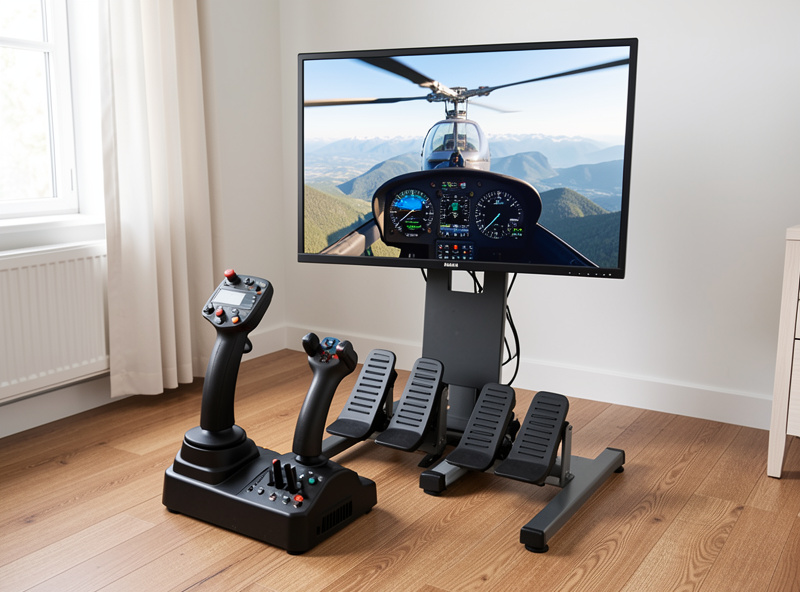
Why a Stick Is the Right Cyclic — But Only the Cyclic
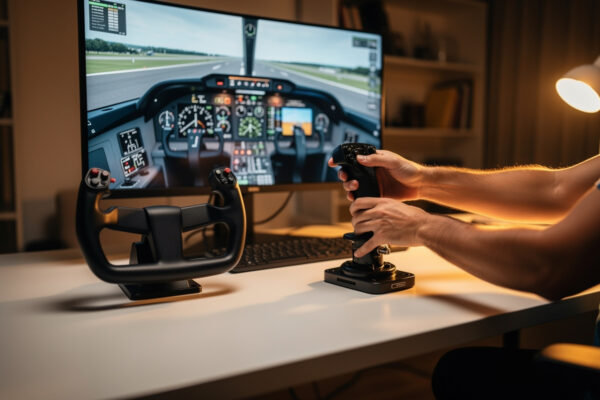
For the cyclic, a stick is genuinely ideal. The cyclic is a centre-stick-style control that you make small, continuous inputs with to keep the rotor disc where you want it, and a flight sim stick maps to that perfectly. A yoke, by contrast, is wrong for a helicopter — there’s no control column in a helicopter, and the yoke’s two-handed, long-travel design doesn’t match the small, constant cyclic corrections rotary flight demands. So if helicopters are your thing, a stick beats a yoke for the cyclic, full stop. This is the one airframe where the yoke loses outright, and it’s worth knowing before you read my general yoke vs stick guide, which is written mostly for fixed-wing flying.
But here’s the catch that the simple “buy a stick” advice misses: a stick gives you the cyclic and nothing else. Without anti-torque pedals and some way to work the collective, you’re flying a helicopter with one of its three controls, mapping the others to a keyboard or a throttle slider, and the result feels nothing like real rotary flight.
The Collective: The Real Third-Control Decision
The collective is the genuinely open question, and it’s where helicopter simming gets its own gear path. You have a few honest options. The cheapest is to map the collective to a throttle lever or quadrant axis — a separate throttle unit’s lever works as a serviceable collective, and that’s how a lot of simmers start. It’s not authentic in feel (a real collective moves up and down, not fore and aft), but it gives you a dedicated analog axis, which is far better than keyboard steps.
The more authentic route is a dedicated collective add-on, which exists as specialist hardware but sits in a different budget and commitment universe — this is the deep end, and I’d point you to the dedicated helicopter-sim community for the current specialist collective options rather than pretend I run every one of them on my own bench. For most simmers getting into helicopters, the practical answer is: stick for the cyclic, pedals for anti-torque, and a throttle lever pressed into service as the collective until you’re sure rotary flight is your home.
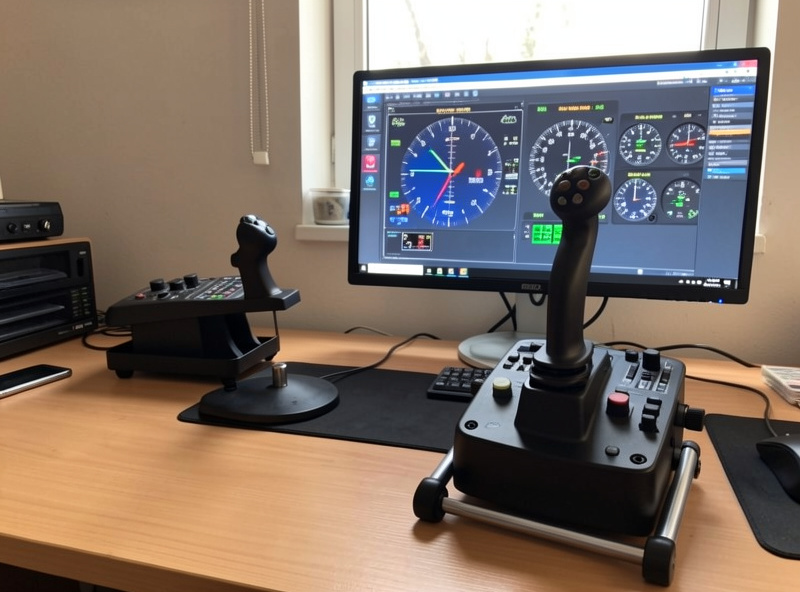
The Helicopter Control Setup, Mapped Out
What each control needs and the honest budget-versus-authenticity trade.
| Helicopter control | Best sim hardware | Budget alternative |
|---|---|---|
| Cyclic (pitch/roll) | Flight sim stick | Any stick; a yoke is wrong here |
| Collective (up/down) | Dedicated collective add-on | Throttle lever / quadrant axis |
| Anti-torque (yaw) | Rudder pedals | Stick twist axis (workable, not ideal) |
| Overall feel | Stick + collective + pedals | Stick + throttle + pedals |
Why Pedals Matter More Here Than Anywhere
If there’s one upgrade that transforms helicopter simming, it’s proper anti-torque pedals. In fixed-wing flying you can get away without pedals for a long time. In a helicopter you cannot — managing torque with the pedals is constant and central to keeping the nose where you want it, especially in the hover. A stick’s twist axis can stand in, but it fights you, because you’re trying to make precise yaw inputs with the same hand and wrist that’s flying the cyclic. Dedicated pedals free that up entirely, and the hover suddenly becomes controllable instead of a fight. This is consistent with my broader view that pedals are one of the highest-value upgrades in the whole hobby, which I lay out in the upgrade order doctrine.
The Gear That Gets You Into Helicopter Simming
If rotary flight is calling, the practical starter kit is a stick, pedals, and a throttle unit — and the PC running the sim matters too: before committing to hardware, see what the flight sim PC build guide says about matching machine to simulator demands to serve as your collective. You can browse current flight sim sticks for the cyclic, rudder pedals for the all-important anti-torque, and a throttle quadrant whose lever doubles as a serviceable collective. As an Amazon Associate I earn from qualifying purchases.
And the standing frame I keep on everything here: learning to hover and fly a helicopter in the sim is one of the most rewarding challenges in the hobby, but it is sim skill — hand-eye coordination and procedure familiarity, not real flight training. Real helicopter flying is extraordinarily demanding and is learned only with a certified instructor in a real aircraft. Enjoy the sim challenge for exactly what it is.
Can you fly a helicopter in flight sim with just a stick?
Only partly. A stick works as the cyclic, but a helicopter also needs a collective for climb and descent and anti-torque pedals for yaw. With just a stick you are flying with one of three controls, which feels nothing like real rotary flight.
Is a stick or yoke better for helicopter simming?
A stick, clearly. The cyclic is a centre-stick control that a flight sim stick maps perfectly. A yoke is wrong for helicopters because there is no control column and its long two-handed travel does not suit small constant cyclic inputs.
What can I use as a collective in flight sim?
The practical starting point is a throttle lever or quadrant axis used as the collective. It is not authentic in feel since a real collective moves up and down, but it gives a dedicated analog axis, far better than keyboard steps. Dedicated collective add-ons exist for the deep end.
Do I need rudder pedals for helicopters in flight sim?
Effectively yes. Anti-torque control is constant and central in a helicopter, especially in the hover. A stick twist axis can stand in but fights you. Dedicated pedals free your stick hand and make the hover controllable instead of a struggle.
Why are helicopters harder to fly in the sim than aeroplanes?
Because all three controls interact constantly. Raising the collective requires anti-torque pedal and cyclic adjustments together. It is a continuous three-handed balancing act, which is exactly why one stick cannot be the whole control solution.
What is the minimum setup to start helicopter simming?
A stick for the cyclic, rudder pedals for anti-torque, and a throttle lever serving as the collective. That trio gives you a dedicated analog axis for each control and is enough to genuinely learn rotary flight before committing to specialist hardware.
Related Guides
- Yoke vs Stick: The Full Aircraft-by-Aircraft Guide
- Why the Airbus Uses a Sidestick
- The Flight Sim Hardware Upgrade Order
More from This Cluster
- “The Real Cost of Switching Yoke to Stick Later”
- “Curves and Deadzones: Making Any Flight Sim Controller Disappear”
- “Airliner Control Logic: Why the Airbus Uses a Sidestick”
- “Why GA Aircraft Want a Yoke: The Control-Column Argument”
- “Yoke or Stick for MSFS 2024: The Most Common Wrong Purchase”
- “Yoke vs Stick for Flight Sim: Which to Buy for the Aircraft You Actually Fly”